
System 7 lottery entries: seven combinations, one draw
Choosing seven numbers for a six-number system creates seven separate six-number combinations. It does not create seven separate draws. The number of selected numbers, the number of lines and the number of events are different fields.
This guide in the plus lottery section expands an invented selection into its component lines. It helps explain a record that already uses this format; it is not a recommendation to buy a larger entry or a statement that any particular Philippines service offers it.
Start with seven distinct numbers
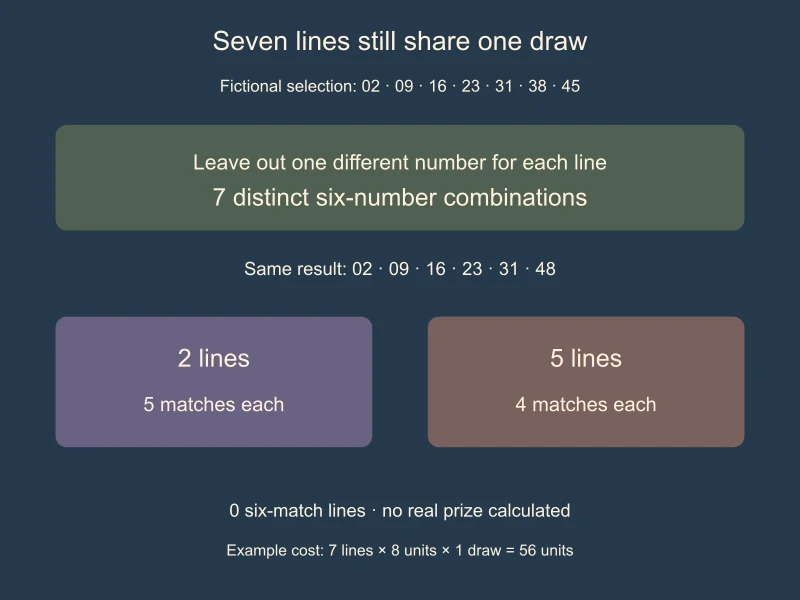
For our example, select 02, 09, 16, 23, 31, 38 and 45. Assume a fictional game uses unordered sets of six different numbers. A full seven-number system contains every six-number subset of the selection. To list them, leave out one different number each time.
| Line | Number left out | Six-number combination |
|---|---|---|
| A | 02 | 09, 16, 23, 31, 38, 45 |
| B | 09 | 02, 16, 23, 31, 38, 45 |
| C | 16 | 02, 09, 23, 31, 38, 45 |
| D | 23 | 02, 09, 16, 31, 38, 45 |
| E | 31 | 02, 09, 16, 23, 38, 45 |
| F | 38 | 02, 09, 16, 23, 31, 45 |
| G | 45 | 02, 09, 16, 23, 31, 38 |
There are seven ways to omit one number, so there are seven distinct lines. Counting all orders of those seven numbers would answer another question. An unordered lottery line does not become a new line merely because its numbers are printed in a different order.
There is a real example of this structure in Singapore Pools’ TOTO rules: the System 7 definition expands seven selected numbers into six-number combinations, and clause 5.8 compares each set separately. That is a specific foreign product example. Our numbers and calculations are original, and no local availability, price or prize table is inferred from it.
Compare all seven lines with the same applicable result
Suppose the fictional draw result is 02, 09, 16, 23, 31 and 48. Five numbers from the seven-number selection appear in the result. The missing result number, 48, appears in none of the component lines.
Lines F and G omit one of the selected numbers that did not appear: 38 or 45. Each retains the five matching numbers, so each has five main-number matches. Lines A through E omit one of those five matching numbers. Each then has four matches.
The line-level record therefore contains two five-match lines and five four-match lines. No component line has six matches. Adding 5 + 5 + 4 + 4 + 4 + 4 + 4 gives 30 repeated match occurrences across the lines, not 30 different drawn numbers or a special combined result. The same drawn number can appear on several lines.
A line count is not a prize count
Our calculation stops at main-number matching. It does not decide whether a line wins an actual prize. That decision also depends on the applicable product rules, additional-number conditions where relevant, accepted entry and draw identity.
If someone labels the record “five selected numbers matched,” ask whether that describes the seven-number selection as a whole or a particular six-number line. Both can be useful observations, but only the component lines can be checked against a line-based prize table. Keep the complete selection and the expanded lines together so that the comparison can be reproduced.
Separate expansion from the number of draws
In a fictional cost model, let each valid six-number line cost 8 units for one draw, with no discount or additional fee. One complete seven-number system costs 7 × 8 = 56 units for that event. If the same complete entry is actually accepted for two draws, the model cost is 7 × 8 × 2 = 112 units.
The seven lines themselves do not justify multiplying by seven draws. Likewise, a two-draw instruction does not reduce the seven-line expansion to just two lines. The existing guide to line and draw costs explains the separate units in the ledger. Use the current accepted record and actual price before applying a cost formula outside this example.
Buying two copies of the same seven-line selection for one event can create two paid copies, but it still covers the same seven distinct combinations. Keep purchased line copies and distinct combinations in separate fields. The distinction matters even when both happen to have the same count in a smaller example.
Do not treat the component lines as independent forecasts
Any two different lines in this full seven-number system share five numbers. Their match outcomes are connected through the same draw. A formula for independent repeated draws cannot be applied merely because there are seven printed lines.
Under a separate assumed uniform six-from-49 model, there are 13,983,816 possible main-number combinations. Seven distinct lines cover seven of them for an exact six-number match in one draw: 7/13,983,816, or 1/1,997,688. This is a combinatorial model, not verification of an operator’s process, an overall prize probability or a forecast. More coverage also requires more charged lines in our cost example; it does not establish a profitable choice.
A record a reader can check
For the worked example, the compact note is: “selection: seven distinct numbers; expansion: seven six-number lines; event: one specified draw; observed matches: two lines with five and five lines with four; cost model: 56 units.” Each field can be checked independently. No payout has been calculated.
The source and complete line enumeration were checked on 10 October 2026. No ticket was bought or draw played for this guide. The useful result is a clearer record: number selection, component lines, draw count and actual rule conditions remain separate.