
Casino table minimums: test each placement before adding the round total
Published — UTC

A minimum marked beside a wager type can apply to each placement. Adding several undersized placements does not necessarily satisfy it. Identify the object the limit governs before adding the amounts.
Two rules, one set of chips
Assume three fictional positions carry 2 units each, making a 6-unit total. Compare two expressly invented minimum rules:
| Rule | Test | Outcome |
|---|---|---|
| At least 5 units across the round | 2 + 2 + 2 = 6 | Total passes |
| At least 5 units on each accepted position | Each position has 2 | Each placement fails |
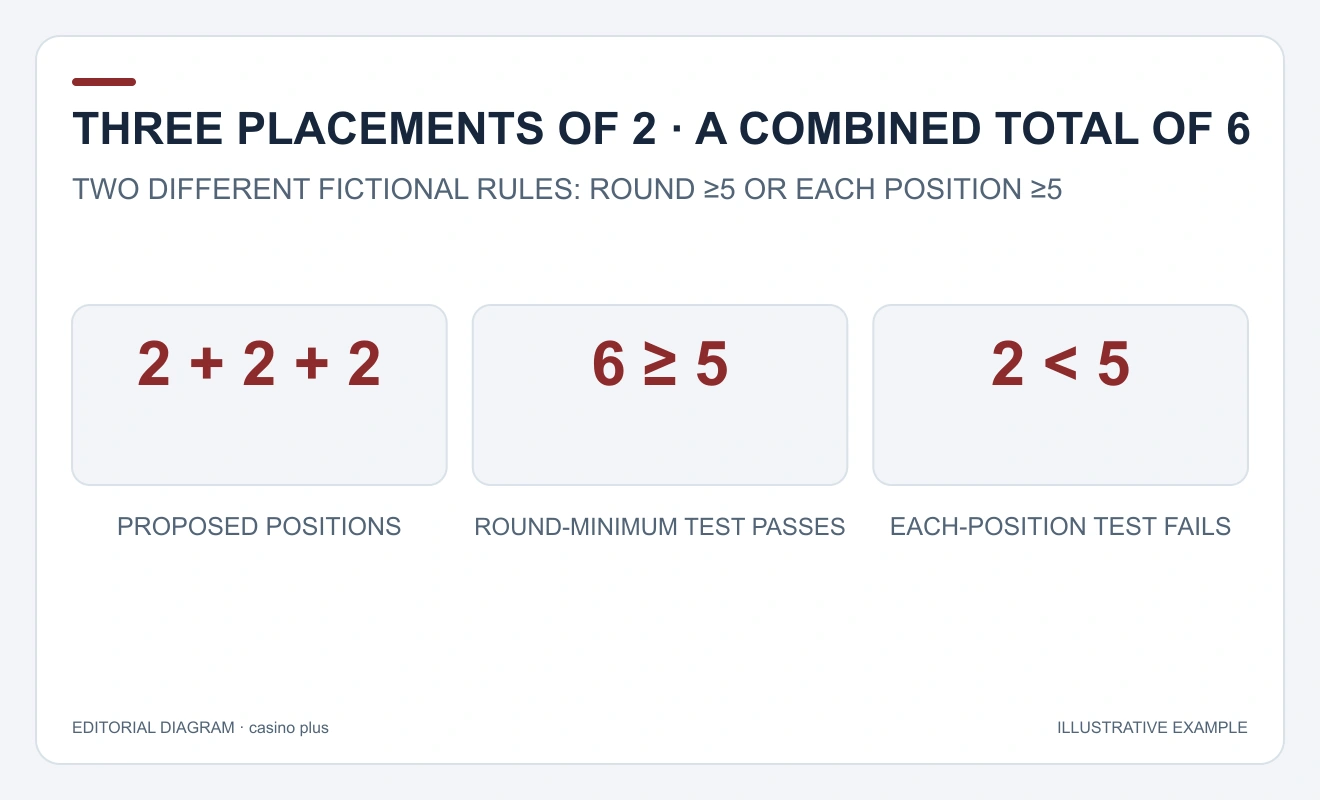
The same sum cannot answer both questions. The second rule concerns three individual values, not one combined value. A real interface may reject, adjust or leave an entry pending; the rule above does not tell us which behaviour a product implements.
Separate main and side limits
A side wager may have its own minimum, maximum or permitted relationship to the main wager. A valid main placement does not prove that a side placement is accepted. Retain the accepted amounts and status for each wager rather than relying on the chips visible before confirmation.
The British transaction-unit reference gives context for individual and total stakes. It is not a local table-limit schedule, and all figures here are illustrative.
A limit comparison record
Write the table and edition, wager type, limit unit, currency, proposed amount and accepted amount. If a displayed “5” lacks a unit or scope, leave that field unresolved. Do not turn it into a verified PHP minimum from appearance alone.
One qualifying position does not make every position valid
Change the proposed amounts to 5, 5 and 2. The total is 12 and two positions meet a per-position minimum of 5, but the third does not. “At least one position passes”, “all positions pass” and “the total passes” are three different statements. At an inclusive minimum of 5, exactly 5 passes while 4.99 does not, provided the unit and permitted precision are the same.
A different denomination changes the comparison
If a fictional interface uses five credits per currency unit, ten credits equal two currency units. Ten credits would therefore fall below a five-currency-unit minimum, despite the larger displayed number. A limit written only as “5” cannot resolve this comparison. Keep the conversion rule with the accepted event, rather than borrowing the denomination selected later.
Main and side placements can disagree
For another expressly hypothetical table, suppose the main minimum is 5 and the side minimum is 1. A main amount of 5 and side amount of 0.50 meet the first requirement but fail the second. Their combined 5.50 does not repair the side amount. Conversely, some rules also require a main placement before a side is allowed; satisfying a numeric side minimum alone would not establish that condition.
Separate a proposed total from confirmed spending
If only two of the three original positions are confirmed at 2 each under a different applicable rule, confirmed cost is 4. Do not retain a proposed total of 6 as a debit unless the account record supports it. Record proposed and accepted amounts in separate columns, and preserve rejection or pending states. The limit comparison explains eligibility; the transaction record establishes what was charged.