
PAGCOR’s helpline ad order: what operators had to replace by 15 July 2026, and what the exclusion numbers show

Short answer — On 17 June 2026 PAGCOR announced that a memorandum dated 9 June ordered all licensees, suppliers, gaming system administrators and venue operators to replace their responsible-gaming advertisements with a template promoting the 24/7 National Problem Gambling Helpline (02-8248-9568). Replacements were due by 15 July 2026, had to stay up until 15 September 2026, and a compliance report was due by 16 July. That gave operators 36 days to comply and fixed a 62-day minimum display window, by our calculation. The helpline itself had launched on 26 May 2026 with 12 para-counselors working three shifts a day.
The order is now past its display window, so the useful questions for a player in the Philippines are different from June: what the rule actually covered, who answers the helpline, what the official exclusion statistics say about demand for help, and what to do if gambling is becoming a problem. All facts below come from PAGCOR’s own pages and data sheets, read on 22 October 2026.
What the 9 June memorandum required
According to PAGCOR’s 17 June headline, the Gaming Licensing and Development Department (GLDD) issued the memorandum. Its main points:
- Who: all licensees, suppliers, gaming system administrators, gaming venue operators and “other concerned entities”.
- What: replace all gaming-related advertisements carrying responsible-gaming messages with the NPGH advertising template.
- Where: PAGCOR Chairman and CEO Alejandro H. Tengco said it covers billboards, wallscapes, digital displays and other out-of-home (OOH) platforms.
- Approval: the helpline ads do not need Ad Standards Council (ASC) approval, although the council issues an Exemption Certificate.
- Reporting: a status report in the prescribed template, due to the GLDD on or before 16 July 2026. Non-compliance can bring regulatory sanctions and penalties that the ASC may impose.
Mr. Tengco’s explanation was short: “Responsible gaming goes beyond awareness. It also means ensuring that help is readily available to those who need it most.” The same headline recalls that in July 2025 PAGCOR had already ordered the immediate removal of gambling billboards and other OOH advertisements, so this order works inside an outdoor-advertising space that was already restricted.
Does it cover online advertising?
The headline’s wording is broad (“all gaming-related advertisements”), but the platforms Mr. Tengco listed are all physical or out-of-home: billboards, wallscapes, digital displays and other OOH formats. Social media posts, app banners and website ads are not named. We therefore do not claim that the order applied to online advertising; if you see a licensed brand’s online ad, the age and responsible-gaming messages in it come from other rules, not necessarily from this memorandum. The memorandum itself is not published on the PAGCOR site, so its exact scope cannot be checked beyond the headline.
The timeline in days
The dates are PAGCOR’s; the day counts are our calculation.
| Date (2026) | Event | Days from previous step |
|---|---|---|
| 26 May | National Problem Gambling Helpline launched with Seagulls Flock Organization Inc. | — |
| 9 June | GLDD memorandum issued | 14 |
| 17 June | Order announced publicly | 8 |
| 15 July | Deadline to complete ad replacement | 28 (36 from the memo) |
| 16 July | Accomplishment report due to the GLDD | 1 |
| 15 September | End of the required display period | 62 from the replacement deadline |
From memorandum to the end of the display period is 98 days, by our calculation. PAGCOR’s headlines list up to 19 October 2026 show no follow-up notice extending or ending the order, so we cannot say whether the helpline ads stayed up after 15 September; that is not confirmed either way.
Who answers 02-8248-9568
PAGCOR’s launch announcement says the helpline connects callers to trained counselors for confidential support, for people with gambling problems and for their family members. It is run in partnership with the Seagulls Flock Organization Inc. (SFO), whose chairperson Teresita Castillo described it as the first round-the-clock hotline dedicated to gambling problems. The helpline is meant for guidance, triage and long-term support, with referral protocols for crisis cases and referrals to treatment where needed.
At launch, Ms. Castillo said 12 para-counselors would work in three shifts per day. If the 12 are split evenly, that is four per shift, by our calculation; PAGCOR did not publish the exact roster. The counselors completed training that included motivational interviewing, cognitive behavioural therapy and call handling, according to the same announcement. The office is inside the PAGCOR Corporate Office in Pasay City.
What PAGCOR’s exclusion data show
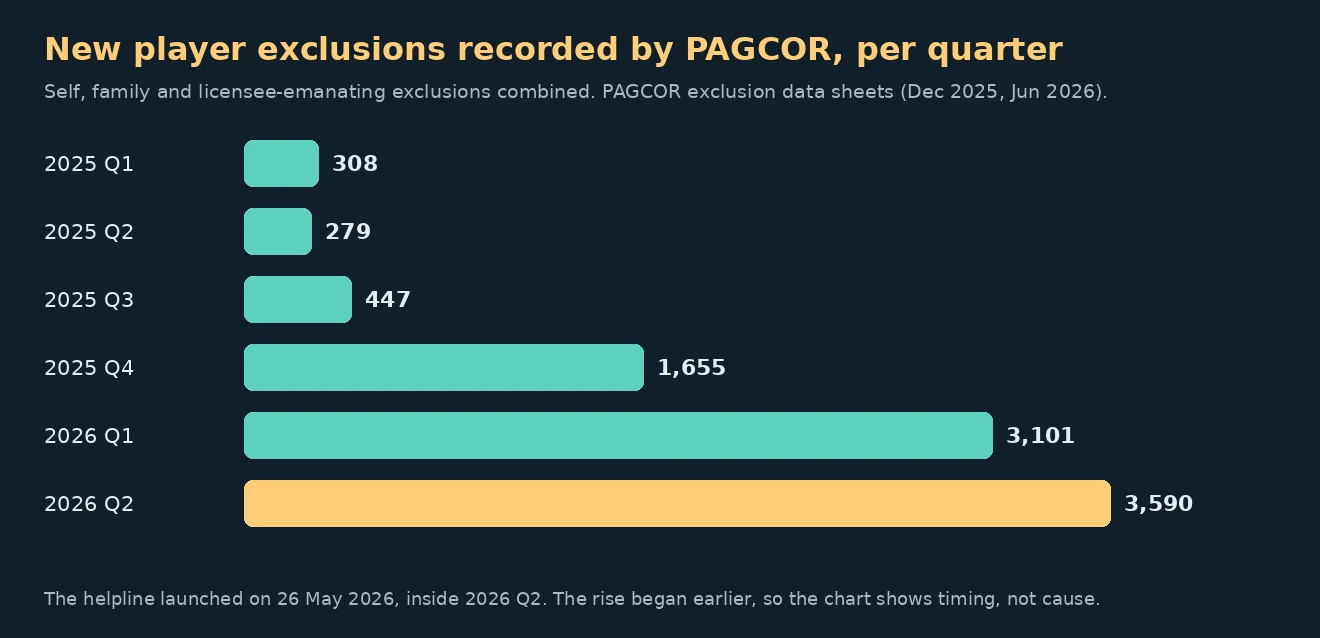
PAGCOR publishes quarterly counts of player exclusions recorded in its National Database of Restricted Persons (NDRP) on its responsible gaming page. An exclusion bars a person from gaming; it can be requested by the player (self), by family, or come from a licensee. The latest sheet, data as of 30 June 2026, and the 31 December 2025 sheet give these new exclusions per quarter:
| Measure | PAGCOR figure | Our calculation |
|---|---|---|
| New exclusions, 2026 Q2 | 3,590 (self 3,528, family 61, licensee 1) | 98.3% were self-exclusions |
| New exclusions, first half of 2026 | 6,691 | 11.4 times the 587 of the first half of 2025 |
| New exclusions, full year 2025 | 2,689 | The first half of 2026 alone is 2.49 times that |
| Existing (active) exclusions | 9,430 on 30 June 2026 | 6.9 times the 1,368 on 30 June 2025 |
| Recorded since September 2013 | 12,886, of which 3,456 expired | 26.8% of all recorded exclusions have expired |
The split by type is the most telling detail. Self-exclusions went from 219 in the second quarter of 2025 to 3,528 in the second quarter of 2026, a 16.1-fold rise, by our calculation. Family-requested exclusions barely moved over the same twelve months, from 52 to 61, and licensee-initiated ones fell from 8 to 1. Whatever drove the increase, it came almost entirely from players asking to bar themselves, not from relatives or casinos acting on their behalf. That is consistent with a campaign aimed at players, but the sheets do not record why anyone applied.
Two cautions. First, timing is not cause. The jump started in the fourth quarter of 2025 (1,655, almost four times the third quarter) and the first quarter of 2026 already had 3,101 new exclusions, before the helpline existed. The helpline launch and the ad order fall inside the second quarter, which rose a further 15.8% to 3,590, by our calculation. The data cannot tell us how much of that rise, if any, came from the helpline campaign. Second, PAGCOR’s cumulative totals were revised between sheets (for example, the 2013–2025 family total differs between the June and December 2025 sheets by more than that half-year’s new family exclusions), so we use the quarterly columns from the latest sheets and do not stitch older cumulative totals together.
What this means if you play
For an ordinary adult player the order changes nothing about how games work, but it puts two practical tools in plain view:
- The helpline, 02-8248-9568, is free to call at any hour, and family members can call too. You do not need to be in crisis to ask for advice.
- Self-exclusion through PAGCOR’s player exclusion process is what most of the 2026 exclusions were: 6,574 of the 6,691 in the first half of the year were self-requested.
- Your own limits: decide a peso budget and a time limit before you start, and do not raise them to chase a loss.
- Age and licence: gaming in the Philippines is for people aged 21 and over, on PAGCOR-licensed platforms only.
Warning signs that are worth a call include borrowing to play, hiding how much you spend, or playing to win back money you already lost. The helpline’s counselors can also point you to treatment if it goes further than advice.
What is not confirmed
- How many operators complied by 15 July, or whether any sanctions followed: PAGCOR has not published a compliance figure.
- Whether the helpline ads remain required after 15 September 2026.
- Call volumes handled by the helpline: not published on the pages we read.
- The exact text and design of the NPGH template: the headline describes it but does not reproduce it, which is why our illustration shows no real advertisement.
Sources (checked 22 October 2026): PAGCOR headlines of 17 June 2026 (ad order) and 27 May 2026 (helpline launch); PAGCOR responsible gaming page and player exclusion data sheets as of 30 June 2025, 31 December 2025 and 30 June 2026. Day counts, ratios and percentages are our own calculation from those official figures.