
Blackjack insurance and even money: why a 2:1 side bet loses at a fresh 8-deck shoe
Published — UTC
Short answer: under Evolution’s standard live blackjack rules (8 decks, blackjack pays 3:2, insurance costs half the main bet and pays 2:1), insurance only breaks even when at least one card in three left in the shoe is a ten-value card. In a fresh shoe, with the dealer showing an ace and you holding two non-ten cards, the chance that the dealer’s hole card is a ten is 128 in 413 = 30.99%. That makes insurance lose 7.02% of what you put on it, on average. Holding a ten yourself makes it worse (7.75%), and holding a 20 worse again (8.47%). “Even money” on your own blackjack is the same insurance bet in disguise: it locks in a 1:1 win, while declining it is worth 3.87% of your bet more on average.
This guide does not tell you how to beat a live table. It takes the rules the game provider publishes, works out the exact card arithmetic for one decision, and converts it into pesos so that you can see what the insurance prompt actually costs. Figures from the provider are marked as rules; everything we calculated ourselves is labelled as a casino plus calculation. Sources were checked on 15 October 2026.
What the rules say
Evolution publishes one rule set for its standard live blackjack tables (Blackjack A–Z, Speed, VIP, Salon Privé and Infinite Blackjack among them). We read it in the Evolution Services SA game rules PDF (pages 142–146), a rules document issued under Evolution’s South African company name and hosted by a licensed operator. The relevant lines are:
| Rule | Evolution standard blackjack |
|---|---|
| Shoe | 8 standard 52-card decks (416 cards) |
| Dealer | Stands on all 17s, including soft 17 |
| Blackjack | Pays 3 to 2 |
| Insurance | Offered only when the dealer’s upcard is an ace; costs half the main bet; pays 2 to 1 |
| Both have blackjack | Push; the main bet is returned |
| Dealer upcard is a ten-value card | No insurance offered and no peek for blackjack |
| Published RTP | Blackjack 99.29% with optimal strategy; Perfect Pairs 95.90%; 21+3 96.30% |
Two details matter for this article. First, the rules say insurance is offered “even when you have Blackjack yourself”, and that the insurance bet is settled separately from your hand. Second, the published 99.29% assumes optimal play, and optimal basic strategy never takes insurance. Every insurance bet you place therefore pulls your own return below that figure.
Why the break-even point is one in three
Insurance is a separate bet that the dealer’s face-down card is worth ten (a 10, jack, queen or king). Suppose you stake 1 unit on insurance. If the hole card is a ten you win 2 units; if it is anything else you lose your 1 unit. The bet breaks even when 2 × p = 1 × (1 − p), which gives p = 1/3. Below a one-in-three chance, insurance loses money over time; above it, insurance would gain.
An 8-deck shoe holds 416 cards, of which 128 are ten-value (four ranks × 4 suits × 8 decks). That is 30.77% of the shoe before a card is dealt, already short of one in three. The question is how much the cards you can see move that number.
The exact chance for your hand
When the insurance prompt appears you know three cards: the dealer’s ace and your own two cards. That leaves 413 unseen cards, and the hole card is one of them. The casino plus calculation below assumes a freshly shuffled shoe:
| Your two cards | Tens left in 413 | Chance hole card is a ten | Insurance result per ₱100 insured |
|---|---|---|---|
| Two non-ten cards (e.g. 9 + 7) | 128 | 30.99% | −₱7.02 |
| One ten (e.g. K + 6) | 127 | 30.75% | −₱7.75 |
| Two tens (a hard 20) | 126 | 30.51% | −₱8.47 |
| Your blackjack (A + ten) | 127 | 30.75% | −₱7.75 |
The result column is (3 × chance − 1) × ₱100, the average outcome of the insurance bet alone. Notice that the hands players most want to protect, a 20 and a blackjack, are exactly the hands that remove tens from the shoe and make insurance a worse bet. “Protecting a good hand” sounds sensible, but the insurance bet does not know what your hand is; it only pays when the hole card is a ten.
Even money is insurance with a different label
“Even money” is the offer to be paid 1:1 on your blackjack immediately, before the dealer checks. Under these rules it is the same thing as buying insurance while holding blackjack. Take a ₱500 main bet:
- Insure (₱250) and the dealer has blackjack: your hand pushes (₱0) and insurance pays 2:1 (+₱500). Net +₱500.
- Insure and the dealer has no blackjack: your blackjack pays 3:2 (+₱750) and insurance loses (−₱250). Net +₱500.
- Decline and the dealer has blackjack (30.75%): push, ₱0.
- Decline and the dealer has no blackjack (69.25%): +₱750.
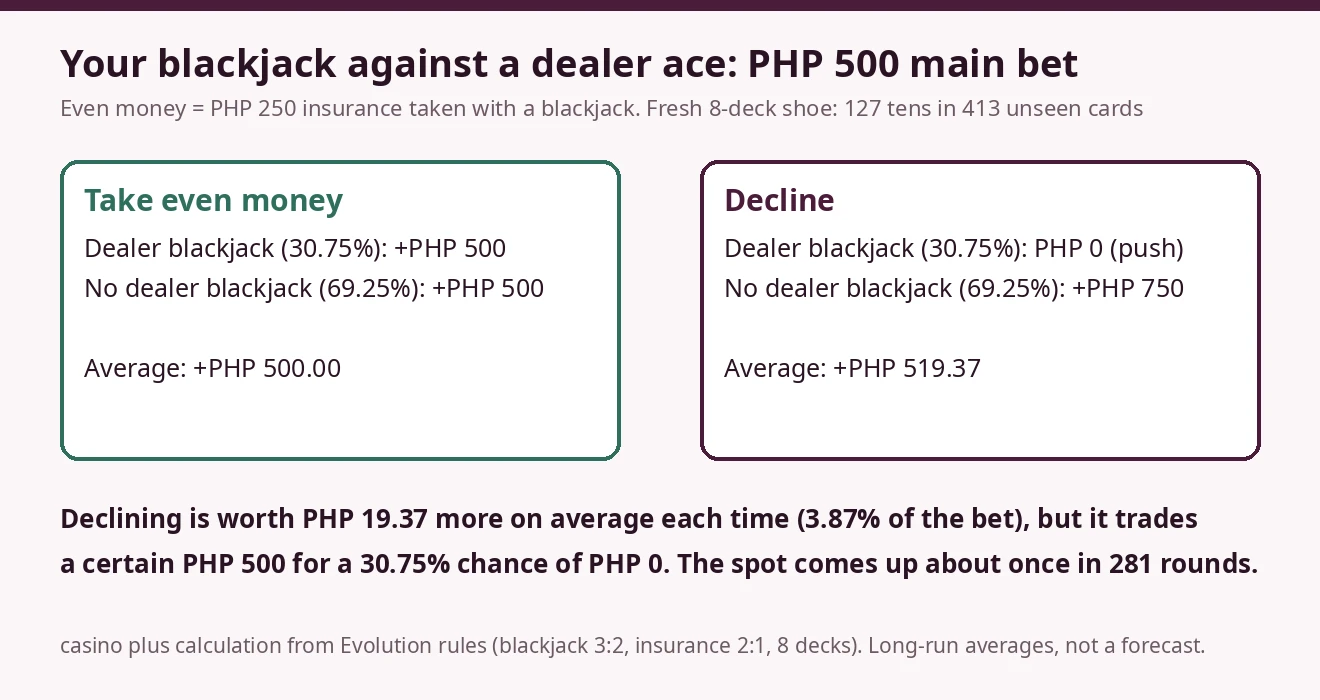
Declining averages 0.6925 × ₱750 = ₱519.37, against a certain ₱500 for even money. The ₱19.37 difference is 3.87% of the main bet, which is exactly the 7.75% insurance loss on a ₱250 side bet. The trade-off is real, though: declining means that about three times in ten you walk away from that blackjack with nothing. Whether a guaranteed ₱500 is worth ₱19.37 to you is a personal choice; the arithmetic only tells you its price. In practice the spot is rare. You need a blackjack (4.75% of hands) at the same moment the dealer shows an ace, which happens in about 1 round in 281.
What the other seats at a live table change
On a live table you can often see other players’ cards before you decide, and Evolution’s standard tables seat up to seven players. Each non-ten card you can see raises the share of tens among the cards you cannot see; each ten you can see lowers it. The chart shows the most favourable case for insurance: you hold two non-ten cards and every extra card you see is also a non-ten.
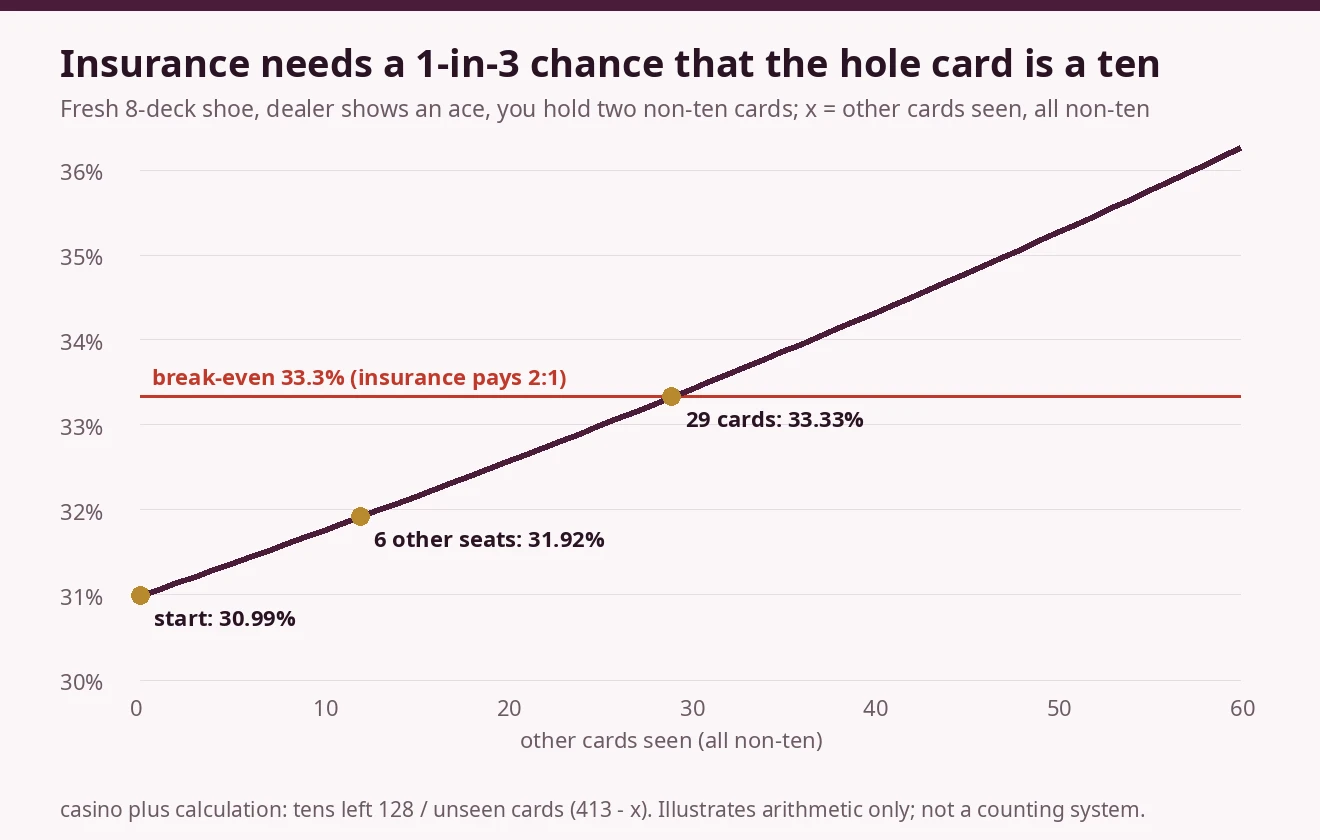
Even if all six other seats show non-ten cards (12 extra cards), the chance reaches only 128 in 401 = 31.92%, so insurance still loses about 4.2% of the insurance stake. The break-even line needs 29 visible non-ten cards with no ten among them, which cannot happen in the first round of a shoe. Deeper into a shoe the mix of remaining cards does drift, but tracking it is a different subject from this article. For a player making the decision at face value, the round-by-round answer under these rules is to decline.
How often you will see the prompt, in pesos
The dealer’s upcard is an ace 32 times in 416, or one round in 13. A worked, hypothetical example: you play 100 rounds at ₱500 and buy insurance (₱250) every time it is offered while holding two non-ten cards.
| Step | Value |
|---|---|
| Expected insurance offers in 100 rounds | 100 × 32/416 ≈ 7.7 |
| Insurance staked | 7.7 × ₱250 ≈ ₱1,923 |
| Average loss per offer (7.02% of ₱250) | ≈ ₱17.55 |
| Average extra cost over the session | ≈ ₱135 |
For comparison, a 0.71% edge (100% − 99.29%) on 100 rounds of ₱500 is roughly ₱355 if you play every hand optimally. Habitual insurance adds about another ₱135, or more than a third on top, without changing anything else about your play. These are long-run averages. Over a single session of 100 hands the swings from ordinary wins and losses are far larger than either figure, so neither number predicts what one evening will look like.
Blackjack frequency and why 3:2 matters
The 3:2 blackjack payout in Evolution’s rules is part of why the base game returns 99.29%. In an 8-deck shoe the chance of being dealt a two-card blackjack is 2 × (32/416) × (128/415) = 4.75%, about one hand in 21. The extra half-unit on each of those hands is worth roughly 2.3% of every bet across the game. For illustration only: a table that paid 6:5 instead would cut that bonus from 0.5 to 0.2 units per blackjack and cost roughly 1.36% of every bet (0.3 × 4.52%, where 4.52% is the chance of a blackjack the dealer does not match). Check the payout printed on the table layout or in the help screen before you sit down, because no insurance decision can recover that difference.
The ten-up case: no peek, no insurance
Evolution’s rules state that when the dealer’s upcard is a ten-value card, insurance is not offered and the dealer does not peek for blackjack. With a ten showing, the hole card is an ace 32 times in 415 (7.71%). The rules extract we read does not spell out how extra money placed on doubles or splits is settled if the dealer then turns over blackjack. We have therefore not calculated that case. Read the help screen of the table you join, because rule sets can differ on this point.
Verified, calculated, not verified
Verified from the provider’s rules: 8 decks, dealer stands on 17, blackjack 3:2, insurance at half the bet paying 2:1, insurance offered only against an ace, no peek with a ten up, push when both have blackjack, RTP 99.29% / 95.90% / 96.30%, up to seven seats per standard table.
casino plus calculations: the 30.99% / 30.75% / 30.51% hole-card chances and the insurance results; the even-money comparison (₱500 vs ₱519.37); the 29-card break-even; the 1-in-13 and 1-in-281 frequencies; the 100-round peso example; the 4.75% blackjack rate and the 6:5 comparison.
Hypothetical: the ₱500 bets and 100-round session are worked examples, not records of real play.
Not verified: the limits, currency and rule edition of the specific table you join, including any version with different payouts or side bets, and how double/split stakes are settled against a ten-up dealer blackjack. Open the table’s help (ⓘ) screen and confirm the blackjack payout and insurance terms before playing.
Before you play
Every blackjack hand is independent of the result before it, and nothing in this guide changes the fact that the house keeps an edge over time. Decide your budget and stopping point before you sit down, do not raise stakes to win back losses, and treat side bets as the most expensive part of the table. Online casino games are for adults aged 21 and over in the Philippines; follow the rules that apply where you live.
Sources (checked 15 October 2026): Evolution Services SA — Evolution game rules, Blackjack section, pp. 142–146 (PDF); Evolution — Live Blackjack game page. Hole-card probabilities, the even-money comparison, frequencies and peso examples were calculated by casino plus.